


Export Shopify orders
Export Shopify orders
Exported Shopify orders facilitate data analysis, backups, and store migrations. It also comes in handy if you need to send your accountant a breakdown of sales every month. The Mixtable spreadsheet app provides the easiest way to export your Shopify orders to Excel or CSV with the fields you need, including the custom attributes saved on an order and the line item properties saved on the individual items in it. Here’s how it works:
Load Shopify Orders in a spreadsheet
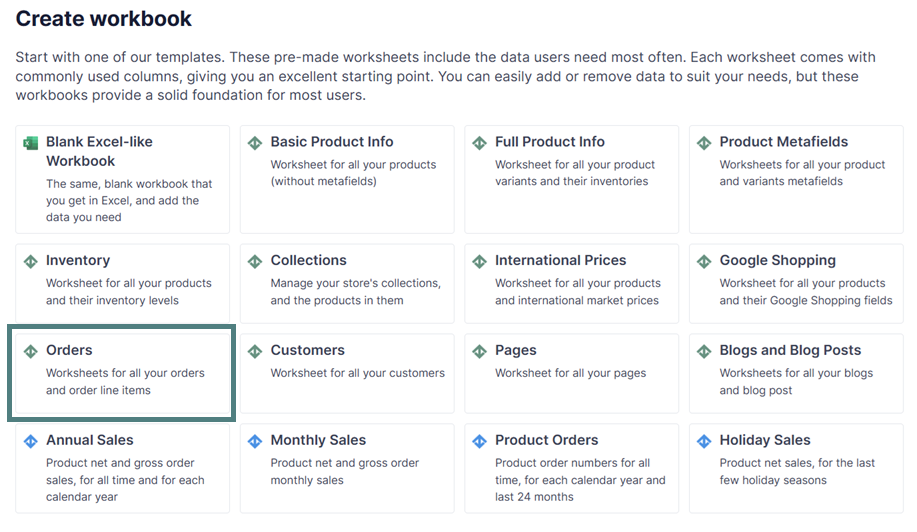
First, set up a worksheet that syncs data to your Shopify orders. You can use the pre-built Orders and Order Items template available in the Create Spreadsheet section.
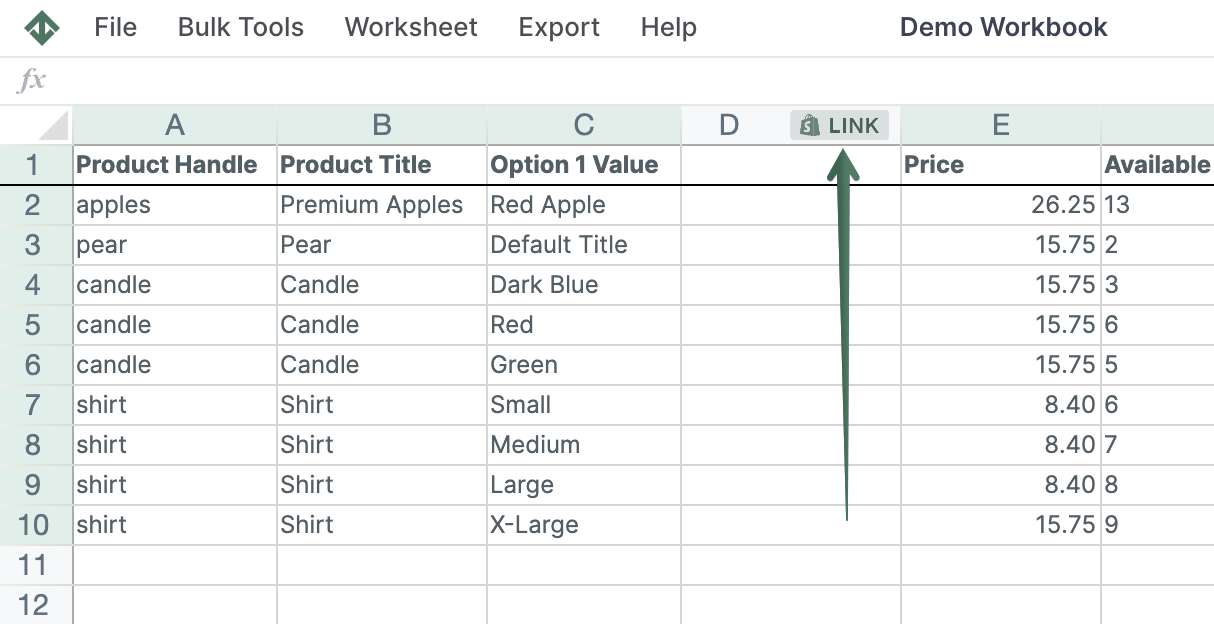
To load new Shopify data, start by selecting an empty column, meaning any column with a non-green header. A green header means the column is already linked to Shopify data. Then click the  button in the column header to open the selection window and choose the data you want to pull in.
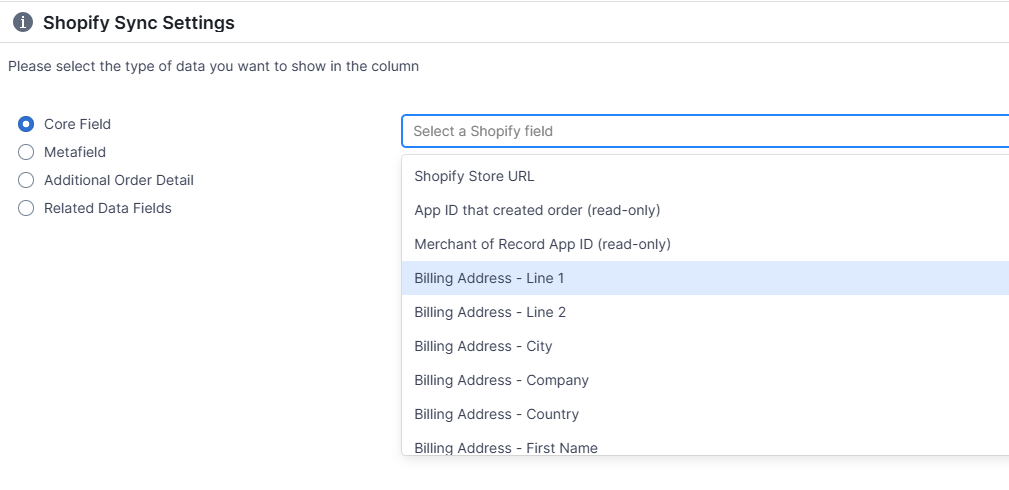
Mixtable will populate the spreadsheet with any desired data.
When the data sync is ready, which could take a few minutes if you have a lot of data, you can trigger the export.
Order fields you can include
When you export your Shopify order data with Mixtable spreadsheet apps, you can include extra data, such as:
- Order number
- Order ID
- Total order amount
- Fulfilment status (fulfilled; unfulfilled; partially fulfilled; scheduled; on hold)
- Financial status (paid, pending)
- Order status page
Note: Because Mixtable order worksheets sync live with Shopify, your data is always current. You can export the most recent order information at any time, without needing to refresh or update.
Add related data for Metafields, Vendors, Product Types, etc. to your Shopify Orders (no line items) worksheet
Connecting order details with Metafields, Vendors, Product Types, etc. information used to mean VLOOKUP formulas. Not anymore! Mixtable now puts this data directly within your reach. Here's how to do it:
If you have already created a Mixtable spreadsheet with your Shopify Order information, you can quickly add related data to it.
Note: The worksheet needs to show order information, e.g., you can use the Orders and Order Items template spreadsheet, or the Orders (no line items) or Orders (with line items) worksheets.
To load new Shopify data, start by selecting an empty column, meaning any column with a non-green header. A green header means the column is already linked to Shopify data. Then click the button in the column header to open the selection window and choose the data you want to pull in.
- From the Shopify Sync Settings window, choose Related Data Fields.
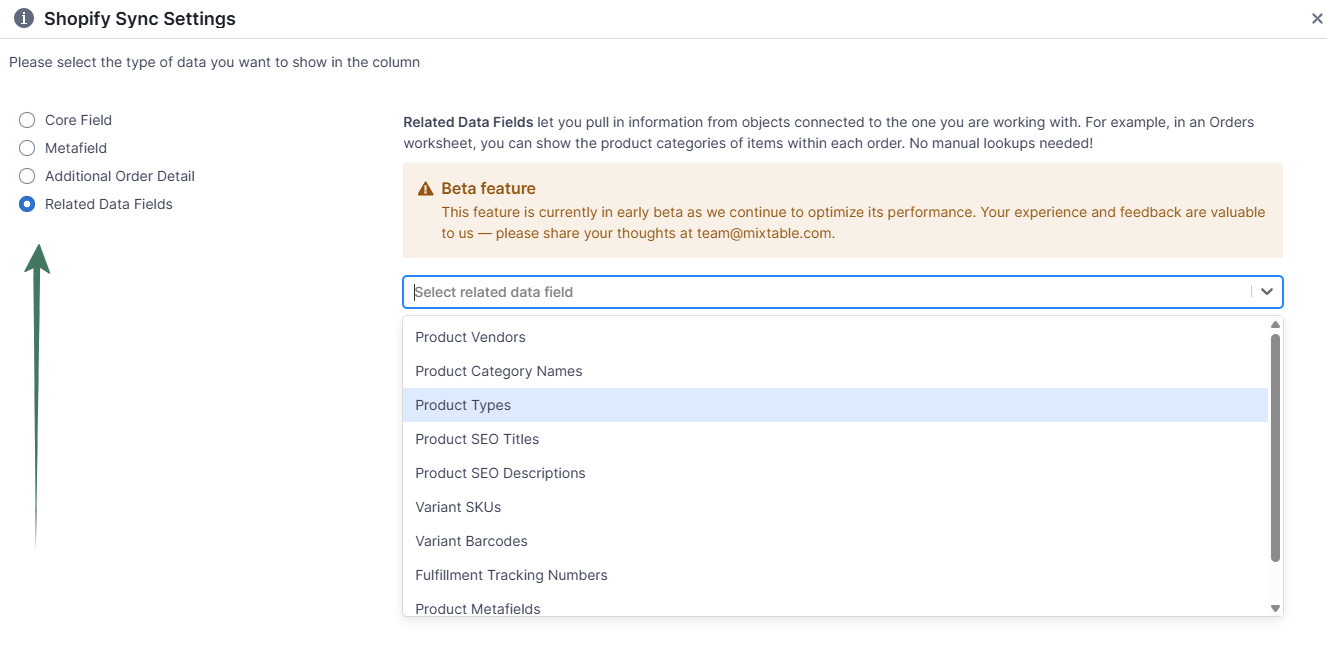
- Then, choose Metafields, Vendors, Product Types, etc. from the drop-down list.
- Allow some time for the data to appear in the columns; you are ready!
Find more about Related Data Fields functionality here.
Export order customizations and additional order details
Some stores collect extra information about the whole order during checkout. Shopify and other apps may call this information order custom attributes, note attributes, or additional order details. Examples include a gift message, a purchase order number, a requested delivery date, or a preferred pickup time.
Mixtable can place each additional order detail in its own spreadsheet column so it is included when you export your Shopify orders:
- Open an Orders (no line items) worksheet.
- Select an empty column, meaning a column without a green header.
- Click the button in that column header.
- Choose Additional Order Detail. Mixtable reads your recent orders and lists the attribute names it finds.
- Pick the attribute you want, then click Save Column.
Mixtable names the column after the attribute and fills it with the value saved on each order. Repeat these steps in another empty column for every additional order detail you want to export.
Export line item properties and product customizations
A line item property is extra information attached to one specific item in an order rather than to the order as a whole. Product option, personalization, and custom pricing apps all use line item properties. Common examples are engraving text, a monogram, a recipient name, a gift wrap choice, and the exact quantity or measurement a customer chose for that item.
To export Shopify line item properties to Excel or CSV:
- Open an Orders (with line items) worksheet. This worksheet gives you one row for each item sold, with the details of its parent order repeated on every row.
- Select an empty column, meaning a column without a green header.
- Click the button in that column header.
- Choose Line Item Custom Property. Mixtable reads your recent line items and lists the property names it finds.
- Pick the property you want, then click Save Column.
Mixtable names the column after the property and fills it with the value saved on each line item. Repeat these steps in another empty column for every property you want to export.
If the attribute or property you need is not in the list
Mixtable rebuilds both lists from your recent order data every time you open the mapping panel, so a name appears as soon as one order carries it. There is nothing to refresh and no cache to clear.
Names that start with an underscore, such as _source, are normal. Apps use them for information they hide from the customer, and they export exactly like any other property.
Important: The app that collects the customization must save it to Shopify as an order attribute or line item property. Mixtable cannot export information that the app keeps only in its own private system. If you are unsure, open one of the orders in your Shopify admin: anything you can see on the order there is something Mixtable can export.
If you can see the information on the order in your Shopify admin but not in the Mixtable list, email Mixtable support so we can investigate.
Export Shopify Orders in a .xlsx or .csv file
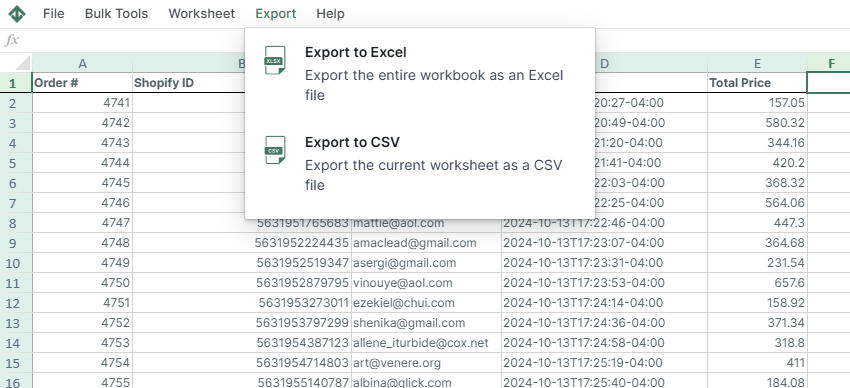
Once your order fields, additional order details, and line item properties are visible in the worksheet, click Import & Export in the top toolbar. You have two choices:
- Export to Excel downloads the entire workbook as an .xlsx file, with every worksheet included.
- Export to CSV downloads only the worksheet you have open at that moment. To get your line item properties into a CSV, open the Orders (with line items) worksheet first, then export.
Every column you mapped is included in the file, so your custom attributes and line item properties arrive alongside the standard order fields.
Tip: If you export orders mainly to total them up in Excel afterwards, Mixtable can do the totalling for you. Mixtable Analytics Spreadsheet builds reports such as store sales and orders by month, and those worksheets export to Excel or CSV exactly the same way.
Keep exploring your Shopify data
Mixtable Explore & Export puts supported Shopify data into an Excel-like spreadsheet that runs in your browser. Choose the fields you need, then export the full spreadsheet to Excel or the active worksheet to CSV.
- Compare all the main approaches in the Shopify to Excel guide
- Export Shopify products, collections, products with metafields, or products with collections
- Export Shopify orders or orders with metafields
- Export Shopify blog posts or Shopify pages
For data types that use manual downloads, refresh the relevant Shopify data before exporting so the file contains the latest available records.
Manage Shopify data in a spreadsheet.
Use Mixtable to edit, sync, analyze, import, and export your Shopify store data without CSV juggling.