


Shopify Total Refund Amount Excluding Tax Analytics
Shopify Total Refund Amount Excluding Tax Analytics
Total Refund Amount Excluding Tax is the money you gave back to customers, with the refunded tax component left out. Excluding tax is what makes it comparable with Gross Sales and Net Sales, which also exclude tax.
How Shopify Total Refund Amount is calculated
Total Refund Amount Excluding Tax = Money refunded - Refunded tax
Leaving tax out is what makes this figure comparable with Net Sales and Gross Sales, which also exclude tax. On the targets that support it, Mixtable also offers a version including tax.
Why refund value belongs in your sales reports
Refunds are one of the few costs most stores never put on a report, and they are rarely spread evenly. A single product line, vendor, or group of customers can account for a disproportionate share of everything you hand back.
Tracking refund value tells you:
- Which products cost you the most after the sale, not just before it
- Whether a high-revenue vendor still looks strong once refunds are counted
- Which parts of your catalog or customer base carry the highest refund cost, so you know where to look first
- How much of a strong month you should expect to give back later
Refund value is where the expensive cases show up. A high-priced product refunded occasionally can cost more than a cheap one refunded constantly, and only the amount reveals that.
Note: This metric measures money refunded in Shopify. A refund does not always mean goods came back, since orders can be refunded for damage, shipping problems, price adjustments, or goodwill. Use Shopify’s return data when you need to know what was physically returned.
Mixtable also offers Total Refund Amount Including Tax on supported worksheets when you need the full refunded amount, which is usually what accounting and reconciliation work calls for.
Add Total Refund Amount to a Shopify data worksheet
-
Open a supported Shopify data worksheet, then select an empty column or insert a new one. Empty columns have a non-green header; a green header means the column is already linked to Shopify data
-
Click the
 button in the column header
 -
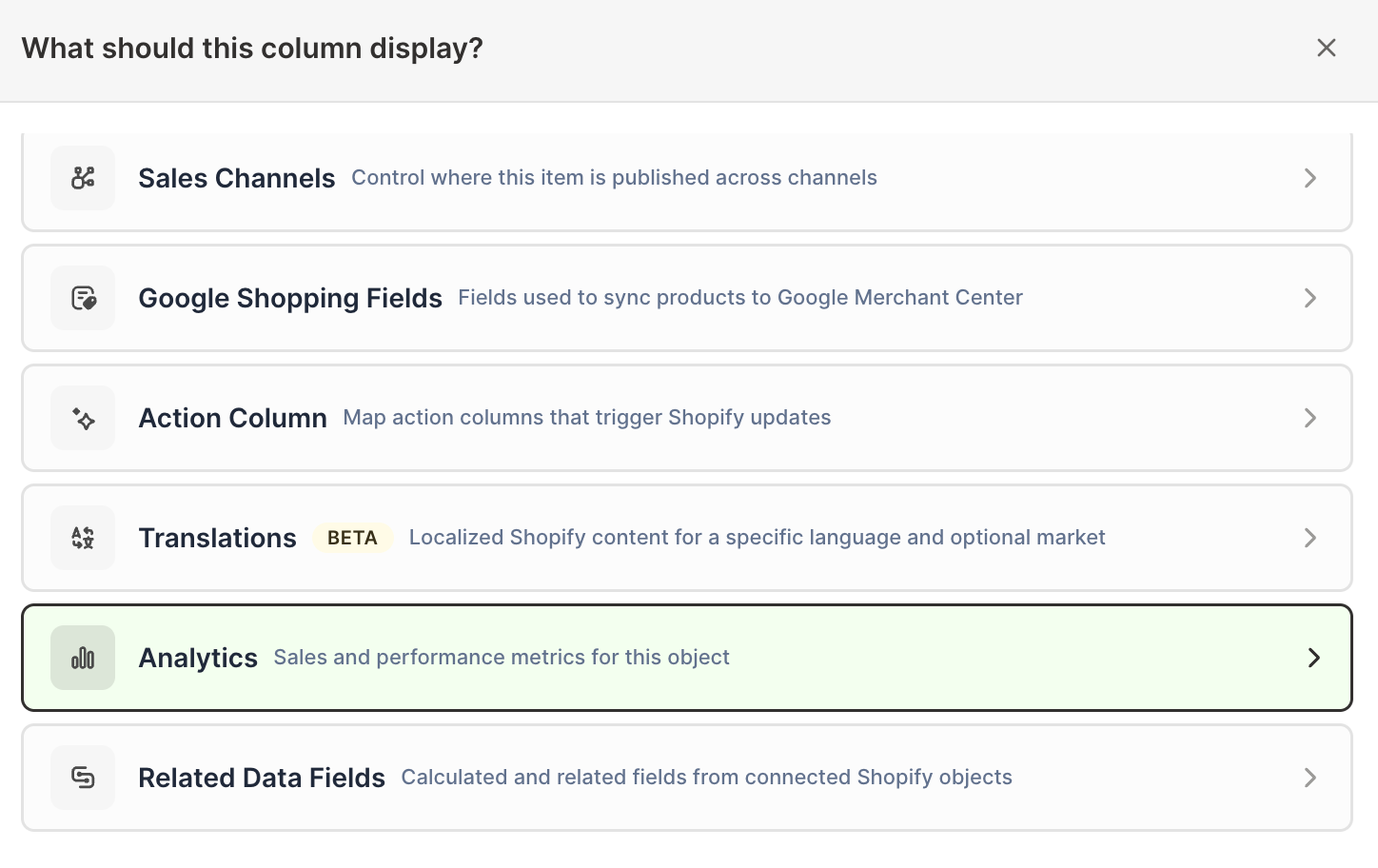
Choose Analytics
-
Under Which metric?, select Total Refund Amount Excluding Tax
-
Under Over what time period?, choose All time, Fixed dates, Rolling period, Calendar year, or Calendar month
-
Under Limit which orders count, add any optional filters supported by the metric
-
Click Save Column
The metric can be calculated beside Shopify products, variants, customers, collections, companies, company locations, and other supported worksheet objects.
Compare refund amounts with a Pivot Table worksheet
- Click the + button beside the worksheet tabs
- Select Reporting worksheet
- Select a ready-made Pivot Table report, or choose Blank pivot table
- Choose the breakdown
- Add Total Refund Amount under Metrics
- Choose the timeframe and optional filters
- Click Create Worksheet
Combine the amount with Refund Count, Percent of Orders Refunded, Refunded Quantity, Net Sales, and Orders Count. That combination separates many small refunds from a few large ones, which is the first thing you need to know before deciding what to investigate.
Track refunds by month or year
Total Refund Amount is available in Time Series worksheets for store, vendor, product type, market, customer segment, and marketing channel breakdowns.
- Add an Reporting worksheet
- Choose a Time Series report, or select Blank time series
- Select the breakdown and Total Refund Amount measure
- Choose monthly or yearly columns
- Click Create Worksheet
Refunds typically lag the orders they relate to by weeks, so a refund spike often lands one or two months after the sales spike it follows. Charting refunds and sales on the same timeline makes that offset easy to see.
Refund analytics and exported refund records
This metric summarizes refund value. If you need the underlying Shopify refund records for accounting or reconciliation, use Export Shopify Refunds instead.
Manage Shopify data in a spreadsheet.
Use Mixtable to edit, sync, analyze, import, and export your Shopify store data without CSV juggling.